BFK | 27.09.2026 | Love Sonnets (1994) + Rosas Danst Rosas (1997)
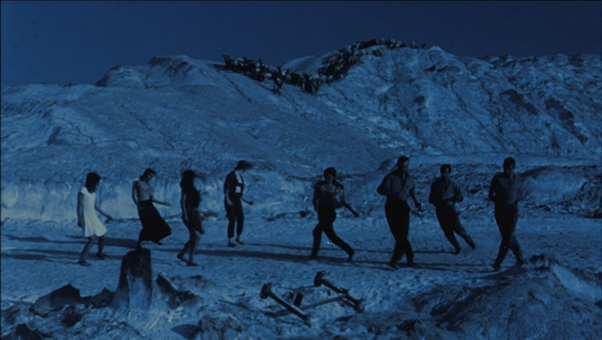
Language through motion: A double bill by director Thierry De Mey with Love Sonnets (1994) and Rosas Danst Rosas (1997)
Love Sonnets (1994)
Visningsformat: DCP
Regissør: Thierry De Mey
Manusforfattere: Michèle-Anne De Mey
Språk: Engelsk, Spansk, Italiensk
Undertekst: Engelsk
Lengde: 30 minutter
ENG:
A film adaptation of Michèle-Anne De Mey’s contemporary dance Sonata 555. Various dancers in various locations dance with one singular motive, love.
Thierry De Mey’s career is vast and varied. At the start of his career, Thierry De Mey was known for musical compositions for contemporary dances. Pretty early he started to get interested in film and in no time, directed a handful of these contemporary dances and put them on film. The first of which is Love Sonnets with his sister and choreographer, Michèle-Anne De Mey, by doing a filmatic take of her work.
Love Sonnets puts the viewers into different locations where at first, you can’t imagine the choreography taking place, and somehow making it fully natural. The gravitas on display by the respective dancers, and the soundscape of the different locations puts an emphasis on every movement, both loud and subtle. Encapsulating every motion with love. Thierry De Mey’s direction and display of the choreography is what sets it apart from a standard “dance film”. Where usually the camera is placed in a total wide shot throughout to fully see the choreography and performances, he makes it completely engaging with his use of rhythmic editing, and camera placements. He makes the film playful, intimate, romantic, surreal, poetic, dreamlike, and at the same time real.
***
Rosas Danst Rosas (1997)
Visningsformat: DCP
Regissør: Thierry De Mey
Manusforfattere: Anne Teresa De Keersmaeker
Språk: Ingen dialog
Undertekst: Ikke nødvendig
Lengde: 57 minutter
ENG:
Rosas danst Rosas is a film built around repetition. Four women sit, lie down, stand, run, throw their hair back and repeat the same movements again and again. At first, the choreography seems almost mechanical. Gradually, small differences begin to matter: a glance, a breath, a slight delay, the growing exhaustion of the dancers.
The austere setting is essential. Empty corridors, windows, chairs and strict architectural lines mirror the geometry of the choreography. The camera does more than document the dance; framing and editing become part of its rhythm.
Many of the gestures are recognisably feminine: touching the hair, adjusting clothes, opening and crossing the legs. Through repetition, they lose some of their everyday meaning and become pattern, labour and physical force.
The repetition becomes almost incantatory, a kind of visual ostinato in which bodies, gestures and rhythms continually return. Its power lies in how little it needs: four bodies, a room, rhythm and time.